
Checking In Vol. 10
Links, songs, photos, etc.


Carnival, Senmonorom, 2016
Greetings all.
Well, it’s boiling outside and the air is on fire, which seems about par for the course these days. Lately I’ve been thinking and writing about some traveling I did about a decade ago, a trip that took me to Okinawa and Southeast Asia and mainland Japan and Mongolia and along the belly of Russia by the trans-Siberian railroad. I did and saw so much across those months, though I don’t know how much I made of it at the time. I also took many, many pictures on my old Rebel SL1, most of which I haven’t looked at in eight or nine years. I’ve embedded a few of them throughout this post; if you like them, then I’ll include more in the future.
Links
First, a short essay on stop-motion masters The Quay Brothers, in the Spring issue of Liberties:
The film thus ends as an elegy for Schulz himself, whose seemingly infinite fictions mask the plundered brevity of his life — a death recorded out in the world which has not yet snuffed out the life of the work. The Quays can manipulate his limbs, bending him into strange shapes, marrying his old words to new symbols. But without their fingers, the figure collapses. Like anything from the Street of Crocodiles, it is a tawdry miracle, a paper mirage. Humans create and mimic and quite often destroy life, but they can only pretend to resurrect it.
At Defector, a review of Gwendoline Riley’s The Palm House:
Yet such lives do go on, however incomplete they tend to be. Late in The Palm House, Laura returns to Putnam, who has not taken his forced retirement well. He, too, is living with a series of absences, chiefly the father he nursed through a final illness. One day he tells Laura a story about a woman his father fell in love with, a Polish waitress at a gussied-up sandwich place. This was late in the old man’s life, well on his way out the door, yet the widower crushes on her all the same, and the two grow close. So close, in fact, that the waitress begins to tell him about her life: her home, her marriage, her grown sons. Years later, Putnam asks his father what became of the woman, and the old man breaks down in tears. “Obviously I was a bit older,” he sobs, “but I had hopes.”
Also at Defector, an essay about one of the great movies of the year, Sophy Romvari’s Blue Heron:
Such documentation can fill in gaps, can call the buried and distant to mind, but it cannot actually bring us back into the world of the past, and it cannot tell us what we do not personally know. As eventually becomes clear, Sasha is not preparing for a film, but rather a performance of her own, a role that will take Sasha beyond herself and her experiences, a leap across the barrier of her own faulty memories and into a key moment from her own past. When she knocks on the door of her childhood home, Sasha appears in the guise of the social worker who counseled her parents to put Jeremy in a foster home, a figure glimpsed briefly in an earlier scene. She tours the house, speaks with her own parents, and attempts to counsel from across the gulf of time—a reassuring act which contains the admission of an inevitable failure. Nothing will work, Jeremy will not get better, and no matter what they do, they will lose him.
That’s right, even more Defector (thanks Brandy!): a review of The Furious that doubles as a reflection on action cinema in the year of our lord 2026:
Tanigaki and Sonomura structure their film in much the same way, leveraging tenderized human flesh against whatever problems narrative might throw down into their path. Wang and Navin team up not from any deep connection, but because neither can best the other in a fight. This is a movie where everyone, from journalists and beat cops to middle-aged businessmen and precocious pre-teens, are ready and able to throw down at the drop of a logo-free baseball cap. Even Rainy quickly goes from problem to protagonist, masterminding a breakout and joining her dad to beat down on some goons with a pipe. The Furious aims for total activation, eliminating downtime in order to wring maximum kinesis out of every possible moment. And thanks to what Jonah Jeng calls Sonomura’s “artful messiness,” the results are both chaotic and precise, maintaining visual clarity without ever sacrificing the manic energy at the heart of any brawl.

Shrine, Plain of Jars Site 1, 2016
Mubi had me write about the New Wave of Irish Horror, as well as Damian McCarthy’s frightful and delightful new film Hokum:
Hokum is a considerably larger production than anything McCarthy has worked on before, and he wisely puts his budget into a series of lavishly dilapidated sets. The gleefully gothic Honeymoon Suite is a marvel of production design, crammed full of objets d’art both creepy and tawdry. Yet the ever-economical director wastes none of it, utilizing every bit of domestic topography—locked doors, shrouded bedframes, even a dumbwaiter down the building’s bricked-in basement—in a series of microcosmic set-pieces. An especially good sequence involving a jerry-rigged elevator relies (and plays) on literal clockwork timing; each time I saw it, the payoff made me jump, and then cackle. There is even a haunted television, and a tape recorder that seems to operate as a conduit to the dead—and whose autonomous operation seems a good metaphor for Hokum itself, sparking on whenever it likes, and forcing viewers to catch up to the action. By the end, the Honeymoon Suite, the Bilberry Woods Hotel, and perhaps even Ireland itself have all been unmasked as zones of occult confusion, where the living are at the mercy of the dead, and those who would deny ghosts and witches and infernal retribution do so at their own peril.
I reviewed Steven Spielberg’s curiously nonexistent Disclosure Day for Commonweal:
Disclosure Day pins everything on a seeing-is-believing climax of surprisingly sunny proportions. Yet despite moments of real terror and magnificence, the result feels strangely inconsequential, if not outright implausible. Spielberg’s past adventures with the extraterrestrial tapped into real currents of cultural unease—from the spiritual yearning that arose from the disintegration of the American family to the country’s newfound sense of vulnerability in the wake of September 11. And the first hour of War of the Worlds, with its images of a civilian population annihilated by advanced airborne weaponry, has lately taken on new and discomfiting resonances.
Finally, I went to MoMA’s new exhibition of its folk art collection and reflected on beauty both behind and beyond the institutional battlements for Apollo Magazine:
In the 1940s, MoMA hung many of these pieces alongside paintings by Henri Rousseau and John Kane in an exhibition called ‘Modern Primitives’; Kane is included in ‘American Folk Art’, alongside the folk-influenced artists Yasuo Kuniyoshi and Marguerite Zorach. Yet these pieces are still clearly segmented from the rest of the collection, the issue of individual artists with an individual perspective rather than semi-anonymous figures collected for how well they represent a particular tradition. Occasionally a Kane or a Rousseau will break through and is separated immediately from the folkloric mass. Derek Hill considered the painters of Donegal’s Tory Island every bit his equal, yet it took his backing to get them shown outside of their own homes. There is always a problem of credentialing, of categorization (often ghettoization) by self-appointed experts.
Yet all throughout the exhibition, you sense the urge that so many people have towards beauty, whatever the limits of their training or their resources. They remind me of my friend’s father, a railroad engineer who lives in a house of his own design, and of my family back in Ireland, who decorate their homes with petrified wood dug up during peat cutting. They are artists, all of them. Don’t expect MoMA to come calling.

Altar near Boeng Yeak Laom, 2016
Songs
This has been a pretty fantastic year for new music, and there’s plenty more to come. Here’s what I’ve been listening to, both new and old, these last few months.
Hana Stretton - Tiarn
A few years ago I fell in love with Stretton’s debut album, Soon, a collection of ambient collage folk songs released by the fantastic Australian label Briarfield Flood Press. Yet even fans of those hazy, long-late-summer ballads are not prepared for what she’s up to on Tiarn, with its watery intermingling of choir samples and synth patches, as shifting and as deep as the ocean.
Shearwater - The New World
If you know me at all then you’ve probably been sick of my love for this great art-rock band for the better part of fifteen years, but that won’t stop me. Their Jet Plane & Oxbow followed me all across that 2016-17 trip, new frontiers opening with every bus ride, every bunk-room night, and they’re still at it. I hope to write more about The New World, but for now, I can’t think of an album that better combines arena rock fuzz with ethiopique jazz jams and stories of discovery and dissolution. The world is falling apart; might as well dance.
Emperor X - Unified Field
In 2024 I caught Chad Methany opening for The Hotelier, and his music hasn’t left me since. Smart, ironic, biting, and hopelessly saddened over the state of our broken world; what else can you want, really? Too many musicians (too many artists period) cultivate a hopeless provincial perspective, but Methany, with his Doctorate and his punk cred, faces the world: he recorded a lot of this new one in Ukraine, and while we don’t get any Rojavan punks or multi-national tax havens on Unified Field, there are plenty of songs about oil fields and industrial pollution. Heart react.
Ida - Dreamdate EP
I think Numero Group is working on a massive of Ida’s I Know About You. Good; it’s hands-down one of the best albums of the 1990s and a criminally overlooked link between alt-rock and slowcore. The rarities included on this new EP, including a lo-fi 7” version of “Thank You,” are as good as it gets. Viva Ida.

Luang Prabang, 2016
The Pastels/Tenniscoats - Two Sunsets
Quite simply this is one of the most beautiful songs I have ever heard. Now you’ve heard it too.
The Tubs - Hard Life
Ooh baby the Tubs are back in town. See you in November at LPR.
Wild Pink - Still Coming Down
Another group that I discovered on my trip, and the rare example of a band who get better with pretty much every record. Their last record was loud and fast; this one is all twangy late-summer jams, fuzzy and scuzzy and with more than a few MJ Lenderman assists. Nine bangers, no skips, and the best is still to come.
The Orchestra (For Now) - Plan 76
Somehow no one informed me of a new prog-adjacent British post-emo collective, but I’ll let that slide for now. We have guitars, we have cellos, we have a guy belting his heart out, possibly about the footy; we have it all, don’t we folks.
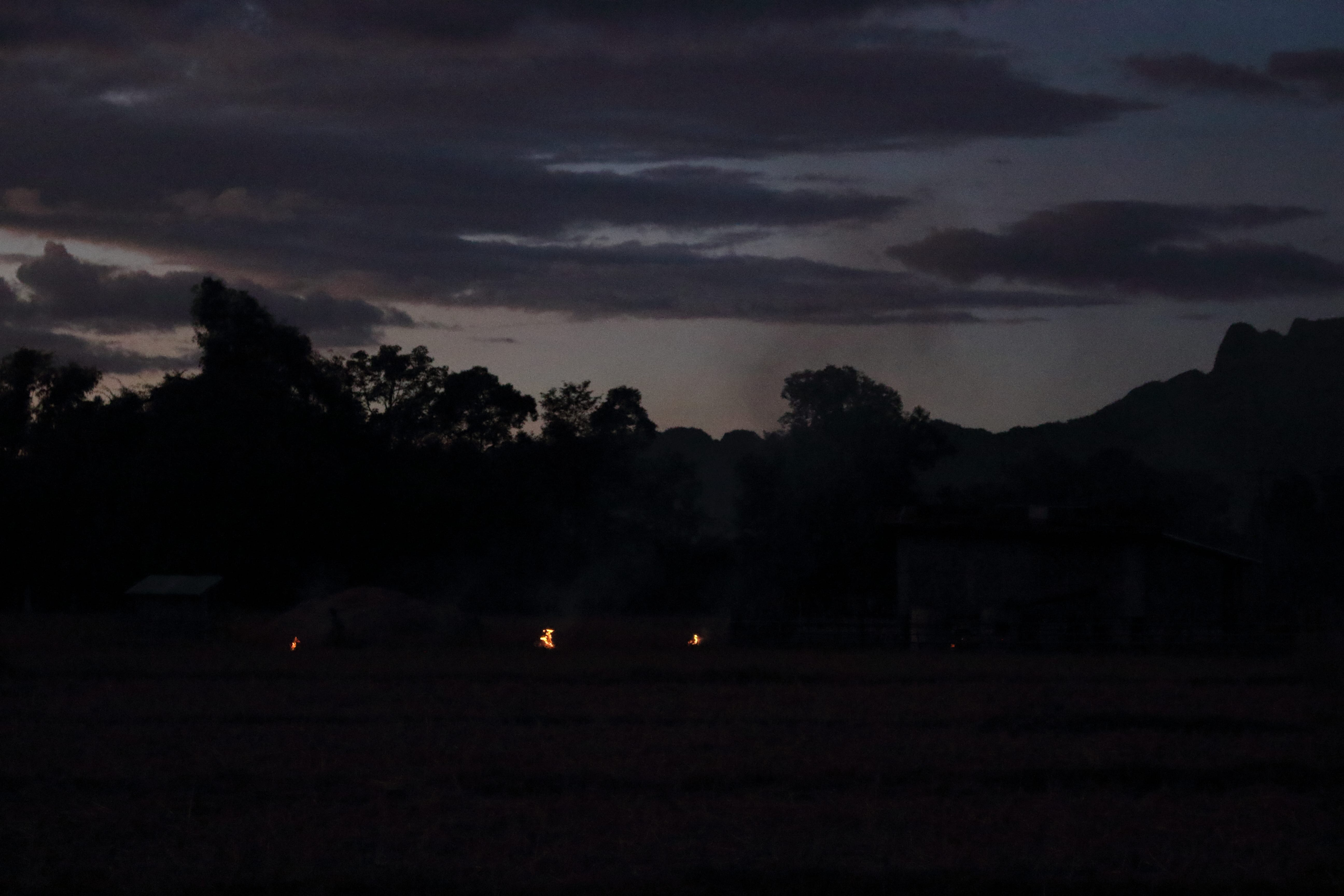
Field Fires near Kong Lor, 2016
These days while I work on my novel I spend much of my time wondering about the young man I was back in 2016. Quite a lot has changed in that time, and my life is so different. No wonder I’m still trying to make sense of it all.
Bis nächste xxxx