
Checking In Vol. 8
Links, songs, and various complaints.

Hey there.
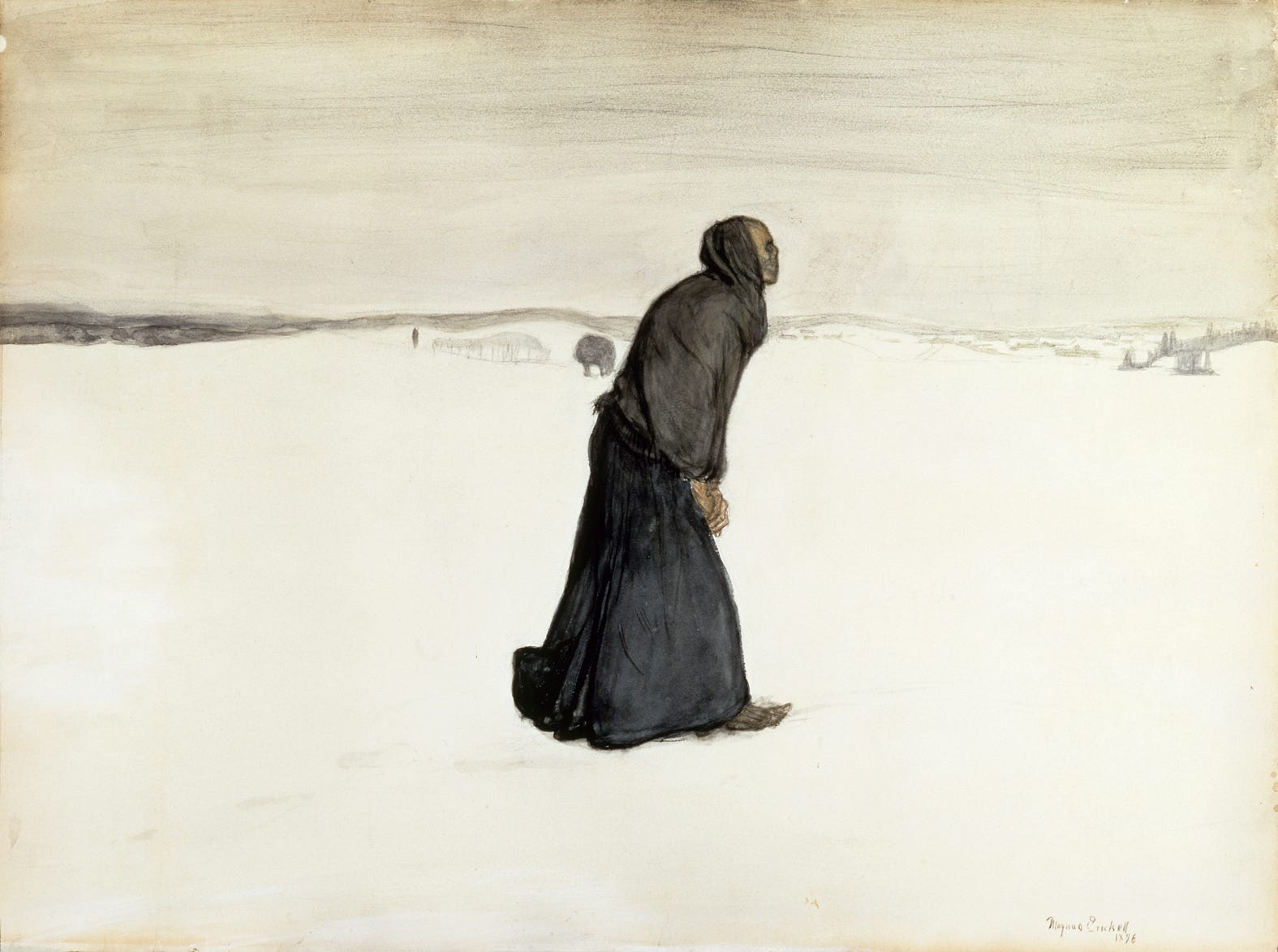
How do these go again? Something about the state of the world, or the state of the business, or at least the state of the city. Maybe I should complain about someone who annoys me, or some book that shouldn’t be popular, or at least about this deep dark winter, which really does seem to be going on a bit long. I should probably cite a blog I half-read, then refer to a micro-controversy no one cares about, and end with a Vox-styled explainer about some subject known to everyone, but apparently not to me. You know, a Substack post.
But who cares about all that. No, here’s a midwinter update full of writing and music and very, very cheery images.
Links
Last month, Liberties published a substantial essay on the relationship between violence, crisis, and artistic reinvention. Includes discussion of Käthe Kollwitz’s pietas, the German invasion of Belgium, shell shock, fascist street gangs, the relationship between Karl Schmitt and Hieronymus Bosch, the paintings of Max Beckmann and the music of Los Campesinos!, among many other things:
Before the war Beckmann had painted disasters, enormous canvases balanced between the impressionists and the old masters. But his experience of “real catastrophe,” writes Koerner, “changed everything.” The disaster was no longer distant; it was everywhere around him. He unveiled The Night in 1919, soon after demobilized soldiers, radical workers, and the newly-formed German Communist Party staged a revolt in the streets of Berlin. With their military weakened and demoralized, the newly-elected Social Democrats called in far-right Freikorps squadrons for support. The communists Rosa Luxemburg and Karl Liebknecht were kidnapped, tortured, and murdered — all with the SPD’s approval. Liebknecht was shot in the back, Luxemburg in the head. Her body was dumped in the Landwehr Canal.
Beckmann had not intended to portray these murders when he began on The Night. But in his psychologically upturned state, he had intuited what Reifenberg would later identify: that the war was not dead and gone, but had seeped into the fabric of Weimar society. Between 1919 and 1922 far-right assassins murdered numerous leading communists, important socialists, and the head of the moderate Center Party. In June of 1922 the Jewish foreign minister Walter Rathenau was shot while leaving his home. His assassins had previously served in a Freikorps unit involved in the suppression of the Bavarian Soviet Republic — with the explicit approval of Rathenau’s own SPD. Other extreme right veterans of the Munich conflict would join Hitler in his 1923 Beer Hall Putsch.
Next, at Defector, an essay about the worst movie nominated for an Oscar in 2026: Clint Bentley’s abominable adaptation of Denis Johnson’s Train Dreams.
These changes help to make Train Dreams into something palatable, a safe choice between seasons of Yellowstone. Johnson’s novella is full of strange and grotesque occurrences. It is a book full of ghosts and monsters, a story with space for spirit visitations and children literally raised by wolves. It includes a description of the world’s fattest man, an encounter with Elvis Presley, and a story told by a dying hobo who raped and impregnated his brother’s adolescent daughter. Bentley is unwilling to engage with any of this. A film imagined under the sign of Malick, it has little to no interest in spontaneity, or allowing discomfort and horror to undercut the wonder. Bentley is afraid that you will not love his characters—or his film—if they are too strange or ugly.
A pair of pieces for Mubi. I wrote a bit about a recent restoration of the Kazakh masterpiece The Fall of Otrar, and the challenges of bringing past worlds to cinematic life:
But the past, as L. P. Hartley wrote, is a foreign country. Even in the fairly recent past, people’s lives were guided by other morals, other logics; they saw meaning where we find dull matter, and were indifferent to questions that seem to us existential. What we know of them comes from the recorded and physical matter that, against all odds, has survived time and its depredations, natural and human, representing only a sliver of life as it was lived. The vast majority of records, books, artworks, and deliberate marks have been lost, decayed, effaced, and what remains of any given time tells us very little about the people who made them, or why. We must bridge that void for ourselves.
I marked the occasion of Mascha Schilinski’s Sound of Falling with an essay on what might be called agrarian literature:
These are not sentimental books; they are full of the violence and suffering of lifetimes spent surviving on the very edge, in a world of beauty and terror. This world is no paradise. Yet his attention, the care with which he observes and records their gestures and aspirations, reveals an innate and irrevocable dignity. Schilinski achieves something similar, bringing a sequence of truncated girlhoods to vivid and disquieting life. Her girls are not victims, not exclusively, and by attending to their passions and quirks, she emphasizes what exactly the cruel and implacable world of the Altmark has done its best to destroy. These cycles prompt many responses: You can flee or fight, float or fall. Yet as the canon of agrarian literature reveals, perhaps it does not ultimately matter which path you take. Churning from season to season, we all arrive in the same place.
The Atlantic gave me a chance to write about the scourge of ethnonationalism and the pioneering comics journalist Joe Sacco:
Safe Area is one of Sacco’s best works because he takes the time to characterize the residents of Goražde, making visible what both propaganda and the fog of war tend to obscure. The book is full of harrowing, enraging war stories, but the main subjects are the people of Goražde, the remaining Bosniaks whose survival presents a firm rebuttal to their besiegers. The Serb ethno-nationalists he quotes seemingly can conceive of living and belonging only in the abstract, atavistic language of ethnicity and blood. But Sacco’s subjects don’t need to ruthlessly assert their right to their home; they belong in Goražde because they are already there. They share a love of pop music, The Bodyguard, and Levi’s 501s; they care more about the mundane facts of their love lives, their education, and their families than ancient feuds or religious rivalries. By focusing on the persistence of private life during wartime, the book widens from an investigation into a kind of communal portrait, literally illustrating the way injustice contorts and is resisted by people, together and alone.
They also let me start off the year with a surprise hit. Somehow, my essay on Helen DeWitt and Ilya Gridneff’s Your Name Here and the virtues of challenging literature was the top-read piece on the Atlantic site for several days in a row. A good many people reached out to me to say that the piece had inspired them to challenge their reading habits in the new year; one woman even said she sent it to her local librarian.
Your Name Here does not treat readers like passive audience members to whom meaning is dictated. It demands work from them, and brazenly risks being misunderstood. This is a welcome development at a time when authors are starting to compete with the ultimate consumer-friendly writing: AI-generated poetry and prose. The text blobs that chatbots produce are becoming more popular, more accessible, and more lifelike—a reader can have a personally customized novel delivered à la carte in minutes. But AI writings are limited by the prompts used to create them and will always reflect the reader-prompter’s existing desires and prejudices, as well as those of the training materials, rather than prodding them to expand. I want my sensibility widened, not pandered to.
Great literature, I would argue, is an active pursuit. It enlists the reader in the act of co-creation and meaning-making. By dramatizing and diversifying its many acts of formation, Your Name Here provides its few but devoted admirers with a surprisingly moving argument for spiky, irregular, even incomplete literature. What emerges is a survival engine—a book that finds its purpose in the collaboration between its co-writers and its readers. That the novel is imperfect, often bewildering, and sometimes a mess is not the point. Its fractured, scattered form, grasping for structure instead of pretending to master it, is an attempt to build a future that will include both author and reader. A simpler book could not do nearly as much.
Finally, I contributed to the Guardian’s ‘my feelgood movie’ column with a completely normal pick: David Fincher’s Zodiac.
Zodiac is, at its heart, a story of the persistent attraction of mystery, where the slow unspooling of surprising facts, incidental details and seeming revelations can become an infinite churn and can even swallow up a life. It touches on the detective story, the newspaper movie and the contemporary paranoiac obsession with lining up the endless stray impressions of daily life into something neat, comprehensible and, most of all, meaningful. In particular, Graysmith’s quest begins with an attempt to safeguard his children, and ends up endangering them. Yet he never considers dropping it, not even when mysterious strangers are calling the house late into the night to breathe over the line. The confidence of the search, the surety of Graysmith’s belief that he will somehow, someday know – the stakes here are existential, though the danger is long in the past and all violence is entirely self-inflicted. To give up the search would be to give up the work of his life, a choice he (and we) never seriously consider.
Songs
The Leaf Library - After the Rain, Strange Seeds
I only found this London group recently but I might as well have been listening to them for years. Their music sounds like home, and their songs feel like they could go on for days, lost in their secret motorik grooves.
Beverly Glenn-Copeland - Laughter in Summer
The sort of record that’ll make you furious. Glenn-Copeland is so foundational to modern music, and has received so little for this work, and still he continues to reimagine his own inexhaustible oeuvre, even while slipping off into dementia. As delicate and as life-giving as you can hope for music to be.
Ratboys - Singin’ To An Empty Chair
They fuckin did it. I loved the last Ratboys album but Singin’ is something else. There’s a lightness to these tunes, a swing that enlivens just how intelligent they are, and how thoroughly these Chicagoans have thought them through. If you wish every song would stop screaming at you all the time, well, here’s your antidote.
Agriculture - The Spiritual Sound
Not that there’s anything wrong with screaming. Ten blistering, mystical tunes that know when to pull back and when to unleash the riffs. This is probably the only metal album to openly reference Jason Molina, but more should.
Bell Witch & Aerial Ruin - Stygian Bough: Volume II
I do love myself some slow-motion sludge, especially if we’ve got a guy with blow-dried locks chanting overtop. This has been my go-to research soundtrack, when I need to read a big book about the Khmer Rouge and can’t let peppy, life-affirming sounds distract me. This happens more than you might think.
Bis nächste xxxx